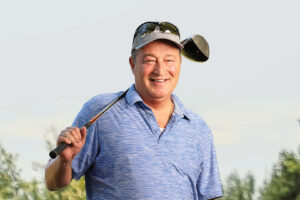


Gary Palmeri was in his laundry room when he started feeling a little wobbly. An hour later, the 59-year-old Howell resident fell when walking in his living room. When his wife, Lisa, arrived home from work, she took one look at him and knew something was wrong.
“I saw a difference in his face when he was speaking, and he was bumping into walls when he walked,” she recalls. “I knew we needed to call 9-1-1.”
The paramedics arrived quickly, recognized stroke symptoms and notified the team at Atlantic Health CentraState Medical Center emergency department, an Advanced Primary Stroke Center, to assemble the Stroke Alert response team. Meanwhile, Lisa called one of Gary’s three daughters, Autumn—a patient care technician at CentraState’s neurology unit—to inform her of the emergency.
Autumn rushed to meet her parents in the Emergency Department, where Gary received a rapid assessment and clot-busting medication to restore blood flow in his brain and minimize damage from the stroke. He spent the night in critical care and was then transferred to the neurology unit.
“It was terrifying, especially when we realized he couldn’t move his left arm or leg,” says Autumn. “But seeing my coworkers in action from a family member’s perspective was a beautiful experience. They were all there for my family and me.”
Starting the Rehab Journey
Gary immediately began inpatient physical and occupational therapy, initially as combined sessions at least once each shift. Both modalities complemented each other in working toward the same goal: helping Gary regain function.
“Physical therapy helps people get from point A to point B, working primarily on the core and lower body,” explains physical therapist Shawn Soloveychik, PT, DPT. “And occupational therapy helps people function at point A and point B, focusing more on the upper body. That crossover – along with Gary’s positive attitude – helped to maximize his progress.”
“Rehabilitation is so crucial after a neurological event like a stroke,” agrees occupational therapist Colleen McGovern, MS, OTR/L, CSRS, a member of his inpatient team. “We start as quickly as we can with as much intensity and repetition as we can, which helps the brain relearn neurological pathways.”
This type of early intervention helped Gary’s progress, from moving into a chair with assistance to walking with two people and a walker. After a week, he was discharged to an inpatient rehabilitation facility and then returned to CentraState for outpatient physical and occupational therapy three times a week. At that point, Gary was able to walk into the hospital – and eventually drive himself to sessions.
In addition to working on mobility, the outpatient rehab team – including McGovern and Soloveychik – helped Gary break daily tasks into smaller, more achievable steps. For example, they started with tasks like gripping a coffee cup, followed by lifting it and then walking while holding it.
“You take the little things for granted,” says Lisa. “Putting on socks or making a sandwich is difficult without the use of two hands. Gary was highly motivated because he wanted to regain his independence.”
Incredible Progress
Through his consistent efforts, Gary returned to work as a construction site manager within about five months and is now able to operate machinery. He recently participated in a breast cancer awareness walk, and he just showed his therapists a new ability that requires full body strength and control: doing five pushups.
“When I can do something new, I get excited about it – and they do, too,” says Gary, who continues his rehab sessions and works out at CentraState Fitness & Wellness. “My wife, daughters and therapists gave me the strength to keep going, and I’m getting stronger every day.”
“It took time, consistency and a positive mindset – along with access to a great team of people who put their heart and soul into their work,” says Lisa. “Without those things, it would have been a whole different outcome.”
Autumn points out that he may not have made the same progress elsewhere.
“Everyone was so encouraging in helping him regain the life he knew,” she says. “The laughter, the care and the attention got him through it. He’s absolutely a fighter, and he’s my hero for that.”
STROKE SERVICES AT CENTRASTATE
Learn more about CentraState’s stroke care services.